Introduction: Why This Divorce Appeal Matters to Dallas Families
Can a Texas court give one spouse more than half of the marital property? Yes. And a September 2026 appellate decision shows exactly how that happens, and how quickly a case can be lost on procedure rather than on the merits.
Per the published opinion, in In the Matter of the Marriage of B.W. and S.W., No. 06-26-00012-CV, 2026 WL 2934994 (Tex. App.—Texarkana Sept. 30, 2026) (mem. op.), the court of appeals affirmed a divorce decree that awarded the husband 60% of the home sale proceeds, all of his community retirement, and a permanent injunction. The wife, representing herself on appeal, raised eleven issues. Only one, a pair of clerical errors in the decree, succeeded.
For anyone weighing whether to hire a Dallas divorce attorney, this case is a practical lesson. It addresses three questions Texas spouses ask us constantly:
- When can fault in the breakup justify a disproportionate property division?
- What happens if you ignore discovery and requests for admissions?
- Why do objections at trial matter so much on appeal?
After more than 25 years practicing family law in Dallas, we have seen these same issues decide real outcomes. Here is what the court held, and what we have learned from it.
Case Background: A Marriage Ended by Family Violence
The Parties and the Initial Dispute
B.W. and S.W. married in 2012. According to the appellate record, the marriage ended after a documented history of family violence by the wife against the husband, culminating in a September 2024 incident involving a firearm inside the marital home. Images from an in-home camera captured the incident, and the wife was arrested and charged with aggravated assault.
The husband filed for divorce days later. He asked the court for a disproportionate share of the community estate based on the wife’s fault in the breakup of the marriage. The trial court then entered a final protective order barring the wife from the residence, and the husband amended his petition to request a permanent injunction.
How the Case Unfolded Procedurally
The wife initially hired counsel, who served discovery on the husband. Weeks later, the court granted counsel’s motion to withdraw, and she proceeded on her own. The court reminded her of upcoming deadlines, but she never answered the husband’s discovery, produced financial records, or filed a sworn inventory.
Critically, the husband had served requests for admissions while she was still represented. Because no answers were filed, those requests were deemed admitted under Texas Rule of Civil Procedure 198.2(c). At trial, the deemed admissions, together with photographs, receipts, and the husband’s testimony, established the abuse, property damage, and $5,802.88 in home repairs.
The record also reflects that motions for new trial were filed after the decree but never heard, because they were unsworn and did not request a hearing. That left the appeal as the only remaining avenue.
The Trial Court’s Decree
The trial court ordered the home sold, with the husband choosing the realtor and price, reimbursed first for repairs, and then receiving 60% of the net proceeds. He also received all community retirement benefits in his name. The court allocated credit card debt between the parties, denied the wife’s spousal maintenance request, entered a permanent injunction, and awarded the husband $7,500 in attorney’s fees.
Legal Analysis: How the Court of Appeals Decided Each Issue
Is a Texas Property Division Required to Be 50/50?
No. Texas Family Code § 7.001 requires a division that is “just and right,” not equal. Relying on M. v. M. 615 S.W.2d 696 (Tex. 1981), the court confirmed that a trial judge may consider fault in the breakup of the marriage when dividing community property.
The standard of review is highly deferential. Under B. v. B., 555 S.W.3d 539, 543 (Tex. 2018), a property division is reversed only when it is “manifestly unjust and unfair.” An appellate court cannot reweigh the evidence, and when no findings of fact are requested, the court implies every finding needed to support the judgment.
Here, the court found “ample evidence” supporting the disproportionate award. The repair reimbursement was supported by receipts. Giving the husband control over the home sale was supported by testimony that the wife refused to sign a listing agreement. Her complaint about the property inventory failed because she never objected to it at trial.
What we’ve learned: Fault-based property claims are won or lost on documentation. Photographs, receipts, police records, and protective orders gave the trial judge a record that no appellate court would disturb. For couples with substantial retirement accounts or real estate, our Dallas high-net-worth divorce lawyer team builds this kind of evidentiary foundation from day one.
Error Preservation: Four Issues Lost Before They Were Heard
The court refused to consider four of the wife’s arguments because they were never raised in the trial court, as required by Texas Rule of Appellate Procedure 33.1:
- Judicial conflict. She argued the judge should not have heard the divorce while also presiding over her criminal case. Because no motion to recuse was filed under Texas Rule of Civil Procedure 18a, the issue was waived.
- Excluded testimony. She wanted her marriage counselor to testify by Zoom without prior arrangement or a subpoena. Without an offer of proof under Texas Rule of Evidence 103(a)(2), the appellate court had nothing to review.
- Criminal records. No Rule 403 objection was made when the records were admitted.
- Attorney’s fees testimony. Opposing counsel testified about fees under Family Code § 6.708(c) without objection.
What we’ve learned: Appellate courts review what happened in the trial court, not what should have happened. Different strategies, such as a timely recusal motion, a subpoena, or a formal offer of proof, might have preserved these complaints for review.
The Fifth Amendment Dilemma in a Divorce Trial
The wife also argued that the judge “silenced” her by warning that her testimony could be used in her pending criminal case. The court disagreed. The warning was accurate, and she remained free to testify and invoke the Fifth Amendment on specific questions. She instead chose not to testify or present any evidence.
This is one of the most difficult decisions a spouse facing parallel criminal charges can make. It calls for coordinated advice from family and criminal counsel well before trial.
Spousal Maintenance Requires Evidence
Texas spousal maintenance under Family Code Chapter 8 requires the requesting spouse to prove eligibility, including that they lack sufficient property to meet their minimum reasonable needs. The only evidence at trial showed the wife was a regional sales director with six-figure earning potential and about $60,000 in her own account. With no contrary evidence offered, the claim failed. Learn more on our Dallas spousal support lawyer page.
Inadequate Briefing and the One Issue That Succeeded
Complaints about the injunction and tax allocation were overruled because the brief contained no citations or analysis, as required by Texas Rule of Appellate Procedure 38.1(i). However, the court did agree the decree contained clerical errors. It deleted references to an “agreement” that never existed and corrected the house number in the injunction.
Precedent Impact Beyond Parker County
This case was transferred from the Fort Worth Court of Appeals under the Texas Supreme Court’s docket-equalization program. Although it arose outside Dallas County, it applies settled Texas Supreme Court standards (M. and B.) that govern every property division in Dallas, Collin, Denton, and Tarrant Counties.
In practical terms, a Dallas divorce attorney can cite this decision to show how much deference trial judges receive on fault-based divisions. It also reinforces how difficult it is to undo an unfavorable decree on appeal. The time to build the record is before and during trial, not afterward.
Key Takeaways for Dallas Divorcing Couples
- Unequal divisions are lawful. Fault, including family violence, can justify a disproportionate award.
- Requests for admissions carry serious weight. Unanswered requests become evidence against you.
- Objections must be made at trial. Arguments not raised there are typically waived on appeal.
- Every claim requires proof. Spousal maintenance and reimbursement claims must be pleaded and supported.
- Read the final decree carefully. Clerical errors can affect enforcement.
These rules apply equally when a Dallas child custody lawyer or Dallas child support lawyer is presenting evidence about children.
Strategic Insights: How Experienced Representation Shapes Outcomes
Alternative approaches were available at nearly every stage: answering admissions on time, filing a sworn inventory, moving to recuse, subpoenaing witnesses, and making offers of proof. An experienced Dallas divorce attorney manages these procedural steps so the merits of your case actually get heard. We give honest assessments of where you stand, not false promises.
Frequently Asked Questions
Can my spouse’s abuse affect how property is divided in Texas?
Yes. Under M.v. M., Texas courts may consider fault in the breakup of the marriage, including family violence, when making a just and right division.
What happens if I don’t respond to requests for admissions in my divorce?
They may be deemed admitted under Texas Rule of Civil Procedure 198.2(c) and used as evidence against you at trial.
Do I need a divorce attorney near me if my case seems simple?
A local Dallas divorce attorney knows Dallas County procedures and judges. As this case shows, procedural missteps can be costly even when the facts seem straightforward.
Schedule Your Dallas Divorce Lawyer Consultation
If you are facing divorce, a fault-based property claim, or a spouse with a protective order, you need a strategy built on evidence and preparation. With more than 25 years of experience as a Dallas family law attorney, Michael P. Granata provides transparent communication about realistic outcomes, a strategic approach balanced with compassion, and the courtroom preparation your case deserves.
Searching for a “divorce attorney near me”? We serve Dallas and surrounding communities, including Irving, Richardson, Garland, Mesquite, DeSoto, Grand Prairie, Lakewood, Highland Park, Cockrell Hill, Lancaster, Seagoville, and Duncanville.
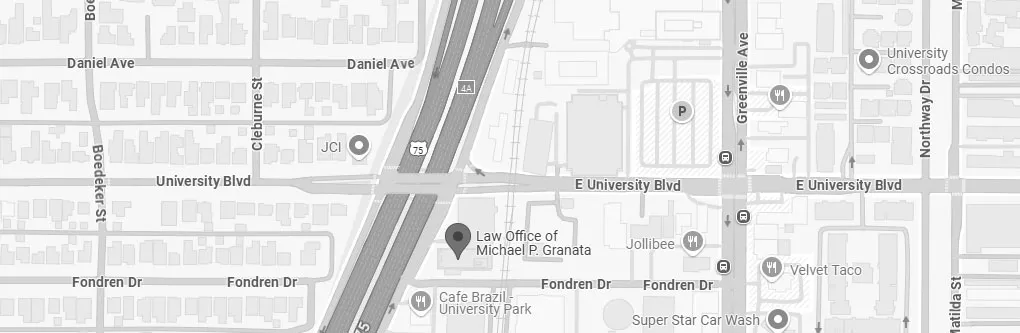
Call (214) 977-9050 or visit our office at 6440 N. Central Expressway, Suite 450, Dallas, TX 75206 to schedule a Dallas divorce lawyer consultation with a Dallas divorce attorney who will tell you the truth about your case. For more case analysis, visit our blog.