Introduction
Many Dallas parents believe that once a child turns 12 and tells the judge where they want to live, the outcome is settled. A recent Texas appellate decision shows the reality is more layered, and that procedural choices made before trial can matter as much as the testimony itself.
Per the published opinion, on August 13, 2026, the Third Court of Appeals in Austin issued its memorandum opinion in N.G. v. B.R., No. 03-25-00569-CV, 2026 WL 2339164 (Tex. App.—Austin Aug. 13, 2026, no pet. h.) (mem. op.), affirming an order that moved two teenage boys’ primary residence from their mother to their father and reversed the child support obligation. The mother, appearing without counsel, raised six issues; the court overruled every one.
What makes this case instructive for anyone consulting a Dallas divorce attorney is not the result but the reasoning. The opinion turns on three quiet but powerful principles: who must request a record of a child’s in-chambers interview, what an appellate court presumes when that record does not exist, and why unrequested findings of fact give a trial court enormous protection on review. Each is decided long before an appellate brief is written, which is why they belong in your first conversation with a Dallas divorce attorney.
Case Background: A 2012 Decree Revisited Twelve Years Later
N.G. and B.R. married, had two sons, born June 2009 and December 2011, and divorced in Bell County in 2012. Their decree named them joint managing conservators with independent authority over medical, educational, and psychological decisions, and gave N.G. the exclusive right to designate the children’s primary residence in Texas. Once both boys turned three, B.R. received standard possession and was ordered to pay child support.
In June 2024, B.R. moved to modify the parent-child relationship, asking to be named the conservator with the exclusive right to designate primary residence, that N.G. receive standard possession, and that she pay support. He invoked Texas Family Code § 156.101(a)(2), which permits modification when the change is in the child’s best interest and the child is at least 12 and has told the court in chambers, under § 153.009, whom the child prefers to designate the primary residence.
At filing, B.R. lived in Temple; N.G. lived in Austin with both sons and her 19-year-old daughter from a prior relationship. While the suit was pending, B.R. moved to enforce possession, and the court found N.G. had withheld the children six days in August 2024.
The case was tried to the bench before an associate judge, with testimony from both parents, B.R.’s brother, the boys’ adult half-sister, and two of N.G.’s friends. On B.R.’s motion, the judge interviewed both boys in chambers after the hearing. Neither party requested a record of those interviews. N.G.’s later request for a de novo hearing was denied as untimely, the district judge adopted the ruling, and N.G. appealed.
Legal Analysis: Six Issues, Three Lessons About the Record
The Standard That Shapes Every Texas Custody Appeal
Texas appellate courts review modification rulings for abuse of discretion, whether the court acted “without reference to any guiding rules or principles.” Legal and factual sufficiency are not independent grounds of error but factors within a two-pronged inquiry: did the court have sufficient evidence to exercise its discretion, and did it err in applying it?
As any experienced Dallas child custody lawyer will explain, this standard is deferential by design. A trial court generally does not abuse its discretion when the record holds some evidence of a substantive and probative character supporting the ruling.
Who Must Ask for a Record of the Child’s Interview?
N.G.’s first issue argued the trial court “failed to ensure a record was made” of the in-chambers interviews, and that the missing record was presumptively harmful to her. The court read § 153.009(f) precisely: on the motion of a party, the amicus attorney, or the attorney ad litem, or on the court’s own motion, the court shall cause a record to be made when the child is 12 or older. No one, including N.G., moved for one, and the court may act on its own motion but need not. No error.
Then came the more consequential holding. Because both boys were over 12, the court treated the interviews as evidence for purposes of the missing-record presumption, and therefore had to presume they supported the final order. The absent record did not weaken the judgment, it insulated it.
Findings of Fact: Ask, or Lose the Argument
N.G.’s third issue asserted that the absence of findings of fact was reversible error. But neither party requested findings, and Texas Rule of Civil Procedure 296 allows any party in a non-jury case to request written findings of fact and conclusions of law. Absent a proper request, omitting them is not error.
The downstream effect appears in the fifth issue: with no findings, every fact necessary to support the ruling and supported by evidence is implied in favor of the judgment.
Lewelling Distinguished: Joint Managing Conservator Status Is Not a “Restriction”
N.G.’s fourth issue invoked L. v. L., arguing that restrictions on parental rights require findings of unfitness or harm. But L. involved grandparents named managing conservators while the mother was cut to possessory conservator on an unsupported significant-impairment finding. Here, N.G. remained a joint managing conservator, her rights were not restricted in that sense, so no unfitness or harm findings were required.
“Comparative Wealth” Versus Best Interest
N.G.’s fifth issue contended the modification rested on comparative wealth rather than best interest, a familiar worry for a parent searching for a divorce attorney near me after an adverse ruling.
B.R. testified that he lives in a seven-bedroom home where each son would have his own room, has worked in finance at the same company over 17 years, and works remotely from 6:00 a.m. to 2:00 p.m., letting him handle school transportation, activities, and homework. He affirmed the importance of the boys’ relationship with their mother, committed to facilitating calls and visits, and said the boys had asked to live with him for roughly two years.
N.G. testified she had recently moved to a three-bedroom home where the boys share a room, and described her work schedule, the adult half-sister’s after-school supervision, and her concerns that the boys do not handle change well, had lived with her thirteen years, and had school friendships. Two friends and her daughter confirmed her household’s structure.
The court’s conclusion is the heart of the opinion. The trial court heard evidence of both parents’ ability to care for their children, and “the testimony demonstrated both parents’ devotion.” No evidence framed the modification as justified by B.R.’s relative wealth. Evidence touching income, home size, and employment existed, but it was not the only evidence supporting best interest, and again, the unrecorded interviews had to be presumed sufficient.
Because the trial court holds broad discretion over which conservator designates primary residence, the appellate role is only to confirm the decision was not unreasonable or arbitrary. The reversal of the support obligation is an ordinary consequence, and one a Dallas child support lawyer flags early: a change in primary residence generally flips who pays.
Denial of a Stay Pending Appeal
N.G.’s sixth issue challenged the denial of a stay pending appeal. Texas Family Code § 109.001 lets a trial court make any order necessary to protect a child’s safety and welfare during an appeal, including suspending the judgment. Because the statute defines neither term, the court applied ordinary meanings, safety as freedom from harm or risk, welfare as doing well.
N.G.’s witnesses at the stay hearing spoke largely to the positive environment in her own home rather than to any risk in B.R.’s care. Asked what evidence showed a crisis requiring a stay, she answered that she was not prepared to answer and that it “could be a possibility.” The denial was therefore neither arbitrary nor unreasonable. Pro se filings are construed liberally, the court noted, but pro se litigants must meet the same standards as counsel.
Key Takeaways for Dallas Divorcing Couples
Does a 12-year-old’s preference decide custody in Texas? No. It opens the door to modification under § 156.101(a)(2), but the court must still find the change is in the child’s best interest.
Must a judge record an in-chambers interview? Only when a party, amicus attorney, attorney ad litem, or the court moves for it. If no one asks and the child is 12 or older, the appellate court presumes the unrecorded interview supports the judgment.
Why do findings of fact matter? Without a timely request, every supported fact is implied in favor of the ruling, which is why a Dallas divorce attorney calendars these requests instead of revisiting them in hindsight.
Strategic Insights: What We Learned From This Case
Alternative approaches in a modification of this posture might have included moving on the record for a transcript of the in-chambers interviews, requesting findings of fact and conclusions of law, calendaring the de novo deadline the day the associate judge ruled, and preparing targeted safety-and-welfare evidence for the stay hearing. None of these changes the facts, but each preserves an argument that otherwise disappears, including in high-net-worth divorce and spousal support matters, where the record runs dense.
Schedule a Dallas Divorce Lawyer Consultation
For more than 25 years, the Law Office of Michael P. Granata has represented Dallas-area parents through custody modifications, conservatorship disputes, and complex divorces. Our approach is straightforward: an honest assessment instead of inflated promises, a strategy built around the record the court will actually review, and transparent communication about realistic outcomes, compassionate with your family, tough where the courtroom demands it.
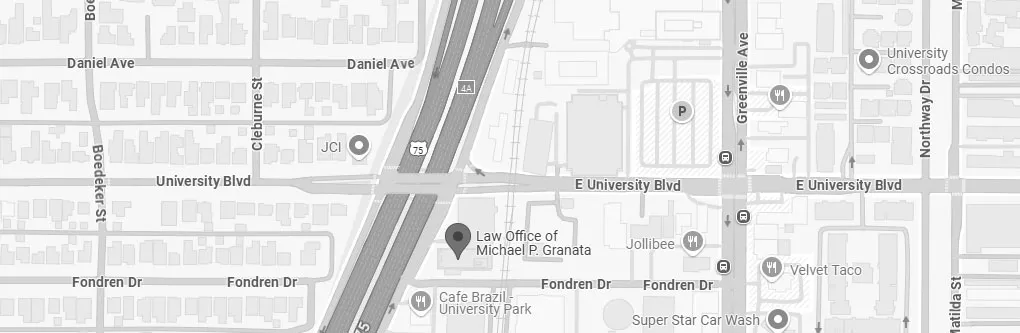
If a modification suit has been filed, or your child has begun asking to change households, a Dallas divorce lawyer consultation is the right first step. Call (214) 977-9050 or visit us at 6440 N. Central Expressway, Suite 450, Dallas, TX 75206.
Serving Dallas and Surrounding Communities
Our Dallas family law attorney team serves clients throughout Dallas and the surrounding area, including Irving, Richardson, Garland, Mesquite, Grand Prairie, DeSoto, Lakewood, Highland Park, Cockrell Hill, Lancaster, Seagoville, and Duncanville. Whether you are still searching for a Dallas divorce attorney or already have a hearing on the calendar, we are ready to help.