Introduction: A Case That Every Dallas Family Law Client Should Understand
If you are navigating a family violence protective order, whether as an applicant seeking protection or as a respondent facing serious restrictions, the procedural details of your case matter enormously. A February 2026 decision from the Fort Worth Court of Appeals, A. v. R. (No. 02-25-00172-CV, 2026 WL 406036), offers a striking illustration of how quickly a default protective order can be entered, and how difficult it can be to unwind once in place.
Per the published opinion, the case arose out of a domestic violence situation in Wichita County, Texas, and ultimately produced a two-year protective order entered by default, meaning the respondent and his attorney were simply not present at the hearing. The court’s analysis touched on four distinct legal issues: judicial disqualification, the scope of protective order pleadings, household member coverage, and constitutional notice requirements. Each issue carries direct relevance for anyone working with a Dallas divorce attorney on a family violence matter.
Understanding this case is not just an academic exercise. It is a roadmap showing what courts expect, and what can go wrong when procedural details are overlooked.
Case Background: Family Violence, a Default Hearing, and a Two-Year Protective Order
The underlying facts involved a former couple, we will refer to them as J.A. and C.R., who had previously lived together. After the relationship ended, C.R. and several household members, including her adult daughter M.A. and M.A.’s boyfriend A.M., continued residing in C.R.’s home. In late November 2024, J.A. allegedly appeared at the home, bit C.R. on the face, and pulled a gun on M.A. and A.M., threatening all of them. A subsequent incident in December involved J.A. pulling C.R.’s hair in front of family members at a dinner.
On December 19, 2024, the Wichita County Criminal District Attorney’s Office filed for a protective order on C.R.’s behalf, citing family violence. A temporary ex parte protective order was entered the following day and a hearing was set for January 2, 2025. J.A.’s attorney moved for a continuance that morning, which was granted without opposition. The same day, the court issued an order extending the temporary protective order, and that order plainly included a new hearing date of January 14, 2025.
Neither J.A. nor his attorney appeared at the January 14 hearing. The trial court heard C.R.’s testimony, admitted relevant evidence including arrest warrants and an emergency protective order, and entered a two-year default protective order prohibiting J.A. from contacting C.R., M.A., and A.M.
J.A. subsequently moved for a new trial, arguing that the relief granted exceeded what was pleaded and that his attorney missed the rescheduled hearing date inadvertently. That motion was denied by operation of law, and J.A. appealed on four grounds. The appellate court affirmed on all four.
This case is directly relevant to anyone consulting a Dallas family law attorney about domestic violence proceedings, protective orders, or default judgment risks in family court.
Legal Analysis: Four Issues, Four Affirmances, and the Lessons They Leave Behind
Issue One: Judicial Disqualification Under Texas Rule of Civil Procedure 18b(a)(1)
J.A. argued that the trial judge, who had previously served as First Assistant in the Wichita County Criminal District Attorney’s Office — was disqualified from presiding over this matter because the same DA’s office had filed the protective order application. Under Texas Rule of Civil Procedure 18b(a)(1), a judge must disqualify himself in any proceeding in which he “has served as a lawyer in the matter in controversy.”
The appellate court rejected this argument for two independent reasons. First, J.A. failed to establish through reliable evidence that the judge was still employed by the DA’s office on the key dates, December 19 and 20, 2024. He submitted unauthenticated newspaper articles, which the court declined to treat as sources “whose accuracy cannot reasonably be questioned” under Texas Rule of Evidence 201(b). Second, even setting evidentiary issues aside, the articles themselves did not actually confirm the judge’s active role on those specific dates.
Critically, the State’s own employment records, submitted in response to J.A.’s motion, showed the judge’s last day of employment at the DA’s office was December 2, 2024, more than two weeks before the protective order was filed. Judicial disqualification claims require a solid evidentiary foundation. Speculation and unauthenticated media sources are not sufficient.
Issue Two and Three: Did the Protective Order Exceed the Scope of the Pleadings?
J.A. contended that C.R.’s application only sought protection for C.R. herself, and that extending the order to cover M.A. and A.M. constituted an abuse of discretion. Under S. v. T., 578 S.W.2d 679 (Tex. 1979), a default judgment must be supported by the pleadings. Relief that exceeds the scope of what was pleaded is improper.
The court disagreed, and the reasoning is instructive. C.R.’s original application expressly sought protection for herself “or a member of [her] family or household.” The temporary ex parte protective order used the same language. The Texas Family Code specifically authorizes protective orders covering household members under Sections 83.001(a) and 85.022. And the OCA standard protective order form, which courts are required to use under Section 85.0221(a), explicitly contemplates protection for applicants and their family or household members.
Moreover, J.A. himself acknowledged in his new-trial motion that M.A. was C.R.’s daughter and that A.M. was a household resident. He could not reasonably claim surprise that those individuals might be included in the protective order’s scope. The court also noted that on December 19, the same day as C.R.’s application, J.A. was arrested for aggravated assault with a deadly weapon based on A.M.’s report, and a magistrate entered a separate emergency protective order for M.A. J.A. had full contextual awareness of who was involved.
This issue reinforces a critical principle for anyone working with a Dallas child custody lawyer or family law practitioner in protective order matters: broad “family or household” language in an application can and does support broad relief in the final order. Respondents should not read protective order applications narrowly.
Issue Four: Was the Reset Hearing Notice Constitutionally Adequate?
J.A.’s final argument was that his attorney did not receive constitutionally adequate notice of the January 14 reset hearing, invoking both Article 1, Section 19 of the Texas Constitution and the Fifth and Fourteenth Amendments to the U.S. Constitution.
The appellate court was unmoved. The January 2 order extending the temporary protective order, which was transmitted electronically to J.A.’s attorney at 2:06 p.m. that same day, plainly included the new January 14 hearing date. J.A.’s attorney received that order. Her own new-trial motion acknowledged it. The reason she missed the date, as described in her motion, was that she was unexpectedly occupied in other counties on January 2 and 3, returned to her office sometime thereafter, and “failed to take a closer look” at the email containing the reset notice.
The court found that J.A. had twelve days’ notice of the rescheduled hearing and twenty-five days’ total notice from when he was originally served on December 20. Failure to read a received court order carefully is not a constitutional due process violation. The court distinguished cases where no notice of any kind was given, such as Ex parte Peterson, 444 S.W.2d 286 (Tex. 1969), from this situation, where notice was received but not acted upon.
For clients working with any Dallas divorce attorney or Dallas child support lawyer, this outcome underscores that courts treat received-but-unread e-filed orders as legally effective notice.
Key Takeaways for Dallas-Area Residents Facing Protective Order Proceedings
This case delivers clear lessons. Protective order applications using “family or household” language authorize broad coverage, potentially including adult children, partners, and other residents. Default orders entered without the respondent present are extremely difficult to challenge on appeal. Received court orders, including those transmitted by e-file, carry legal notice weight regardless of whether they were carefully reviewed. And judicial disqualification arguments require authenticated, reliable evidentiary support, not newspaper articles. Anyone facing a Dallas family law attorney across the table in a protective order proceeding should treat every deadline and every document with urgency.
Strategic Insights: What We’ve Learned From This Case
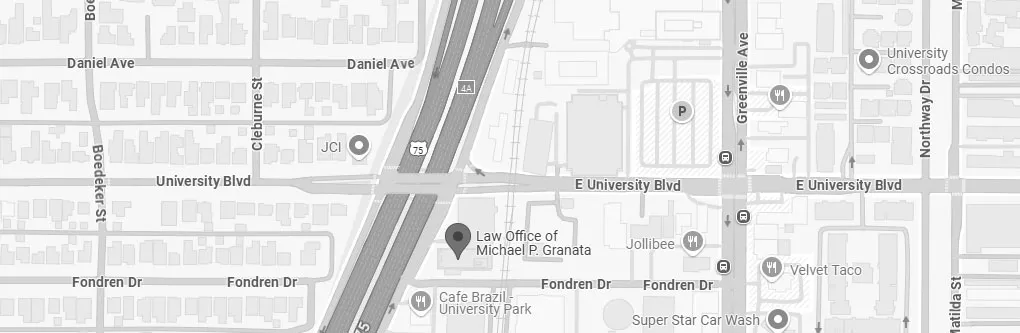
Cases like A. v. R. illustrate how alternative approaches at the trial level can affect appellate outcomes significantly. Different strategies might have included a more thorough review of electronic filings in the days following the continuance, a proactive follow-up with the clerk’s office to confirm the reset date, or an earlier and more specific objection to the scope of the pleadings. For respondents in protective order matters, the window between service and hearing is narrow, making engaged, attentive representation from the outset essential. The Law Office of Michael P. Granata brings more than 25 years of Dallas family law experience to exactly these high-stakes procedural situations.
Facing a Protective Order in Dallas? Talk to an Experienced Dallas Divorce Attorney Today.
Whether you are seeking protection from family violence or responding to a protective order that affects your rights, the decisions made in the earliest stages of your case shape everything that follows. At the Law Office of Michael P. Granata, we provide honest assessments, not false promises, and strategic, compassionate representation for clients throughout Dallas, Irving, Richardson, Garland, Mesquite, DeSoto, Grand Prairie, Lakewood, Highland Park, Cockrell Hill, Lancaster, and Duncanville.
If you are searching for an experienced divorce lawyer in Dallas or need a Dallas divorce lawyer consultation about a protective order, custody dispute, or family violence matter, we are ready to help. Contact our office today to schedule your confidential consultation. When the stakes are this high, experience and attention to detail make all the difference, and with over 25 years serving the Dallas area, we are prepared to stand with you every step of the way.