A clear guide to the automatic injunctions that bind you the instant your case is filed — and how experienced legal guidance keeps you on the right side of them.
Deciding to end a marriage is one of the hardest things a person ever does. If you are reading this, you are probably exhausted and anxious, trying to protect your children, your home, and your future all at once. That is a heavy load to carry, and you deserve straight answers rather than legal fog.
Here is something almost no one tells you up front: the moment a divorce is filed in Dallas County, a court order quietly takes effect that controls what you are allowed to do with your money, your property, your children, and even your pets. It arrives stapled to the back of the petition, written in dense legal language, and most people never read it closely until they have already broken a rule they did not know existed.
This guide explains that order in plain English — what it forbids, when it starts, what happens if you slip up, and how the right Dallas divorce attorney helps you move forward without sabotaging your own case. Knowledge here is genuinely protective. The mistakes that hurt people most in a Dallas divorce are usually made in the first two weeks, before they fully understand the rules.
What Is a Dallas County Standing Order?
A Dallas County standing order is an automatic court order that applies to both spouses the moment a divorce or a suit affecting the parent-child relationship (SAPCR) is filed. It is sometimes called an “automatic temporary injunction.” Unlike a temporary restraining order that one spouse asks a judge to sign, the standing order is already adopted by the Dallas County Family District Courts. It applies to every qualifying case — no request, no hearing, no signature required.
| In one sentence: A Dallas County standing order is a binding set of “do-not” rules that freezes the status quo — your assets, your debts, your children’s routine, and your conduct toward your spouse — so that nothing important changes before a judge can weigh in. |
The purpose is fairness and stability. The court does not want either spouse to empty a bank account, hide the kids, canceling the family’s health insurance, or run off with the retirement savings while the case is pending. The standing order keeps everyone in roughly the same position they were in the day before filing, so the judge can divide things and decide custody on a level playing field.
Dallas is not alone in using these orders — Collin, Denton, Rockwall, and Kaufman counties use them too — but the orders are county-specific and differ in their details. Notably, the Dallas County order even includes protections for family pets and companion animals, which several neighboring counties do not. Because the wording matters, it is wise to review your specific order with a knowledgeable family law attorney serving Dallas before you make any major move.
When Does the Standing Order Take Effect — and How Long Does It Last?
Timing is where people get caught off guard. The order does not bind both spouses at the same instant:
- The spouse who files (the Petitioner) is bound the moment the case is filed with the district clerk.
- The other spouse (the Respondent) is bound the moment they are served with the petition and order.
In other words, if you are the one filing, you are restricted before your spouse even knows the case exists. You cannot file in the morning and quietly move assets in the afternoon — you are already under the order.
The order stays in force throughout the case. If you disagree with any part of it, you may request a hearing to contest it, but that hearing generally must occur within roughly 14 days of filing. If no one contests it, the standing order simply continues as a temporary injunction until the judge signs temporary orders or the divorce is finalized. Practically speaking, for most couples it governs the entire divorce.
What You Can’t Do the Moment You File: The Automatic Injunctions
This is the heart of the order. The restrictions fall into several categories. The list below is a plain-English summary — your actual order is the controlling document, and an experienced Dallas family law attorney can walk you through how each line applies to your specific situation.
1. You Can’t Sell, Hide, Transfer, or Destroy Marital Assets
This is the rule people break most often without realizing it. Once the case is filed, you generally may not sell, transfer, give away, encumber, conceal, waste, or destroy marital property. That includes the house, vehicles, bank accounts, investment accounts, business interests, and valuables.
Common violations people don’t expect:
|
You are still allowed to make normal, ordinary-course transactions — buying groceries, paying the mortgage, keeping a business running, and covering reasonable living expenses and attorney’s fees. What you cannot do is anything outside the ordinary course that diminishes the marital estate. When large assets or a closely held business are involved, the stakes climb quickly, which is why people facing complex estates often work with a lawyer experienced in high-net-worth divorce and forensic asset tracing.
2. You Can’t Move the Children or Disrupt Their Lives
The order protects children’s stability. Generally, you may not:
- Remove the children from the state with the intent to change their primary residence while the case is pending
- Hide or secrete the children from the other parent, or withdraw them from their school or daycare
- Disrupt or disturb the children’s established routines and daily life
- Disparage the other parent to or around the children
- Discuss the divorce litigation with the children or let them hear it
These rules are not about taking your children away from you — they are about keeping the children out of the crossfire until a custody schedule is in place. If parenting time is contested, a child custody lawyer in Dallas can help you seek temporary orders quickly so you have a clear, enforceable schedule rather than relying on goodwill.
3. You Can’t Change Insurance Coverage or Beneficiaries
Many people instinctively want to remove a soon-to-be-ex from their policies. The standing order forbids it. You generally may not cancel, alter, or let lapse the family’s life, health, automobile, or homeowner’s insurance, and you may not change the named beneficiaries on life insurance, retirement accounts, or payable-on-death designations.
The goal is to keep the family protected during the case. Changing a beneficiary or dropping a spouse’s health coverage mid-divorce is a classic violation that can land you in contempt and damage your credibility with the judge.
4. You Can’t Drain Accounts or Run Up Unusual Debt
Beyond protecting specific assets, the order restricts financial behavior generally. You may not make unusual or extraordinary withdrawals, transfers, or expenditures, and you may not borrow against marital property or open new credit lines in a way designed to burden the estate. Reasonable spending for necessities and legal fees is fine; a sudden cash-out, a maxed-out credit card, or a “spite” spending spree is not.
If you are worried about how you will pay bills while the case is pending, that is a legitimate concern with a legitimate solution: temporary support. Rather than self-help, ask the court for interim spousal support or child support, which a judge can order to keep both households stable.
5. You Can’t Harass, Threaten, or Behave Abusively Toward Your Spouse
The order governs conduct, not just dollars. You may not threaten, harass, or use violence against your spouse, and you may not communicate with them in a coarse, profane, vulgar, or threatening manner — including by phone, text, email, or social media. The urge to vent is human; acting on it is a violation.
| Reality check: That angry text, that public Facebook post about your spouse, that 2 a.m. voicemail — all of it can become evidence, and all of it can violate the standing order. Assume everything you write or post will be read aloud in a courtroom. |
6. You Can’t Open the Other Spouse’s Mail or Snoop on Their Accounts
Privacy is protected too. You generally may not open or read mail addressed solely to your spouse, and you may not access their email, texts, or social media accounts without permission. You also may not destroy, dispose of, or alter personal records, business records, or electronic data relevant to the case — quietly deleting a relevant social media post can itself be a violation.
7. You Can’t Harm, Hide, or Get Rid of the Family Pet
This is a feature of the Dallas County order that many people miss. You may not harm, hide, abandon, transfer, or dispose of a family pet or companion animal during the case. If the family dog or cat is a point of contention, the order keeps the status quo until it can be addressed.
What You Can Still Do While the Standing Order Is in Effect
The order is not designed to freeze your entire life. It specifically allows you to keep functioning. You can still:
- Pay your normal bills, rent or mortgage, utilities, and ordinary living expenses
- Buy food, clothing, medicine, and other necessities for yourself and your children
- Operate a business in its ordinary course
- Hire and pay a divorce attorney to represent you
- Take reasonable actions to protect yourself or your children from immediate harm
The line is “ordinary and necessary” versus “unusual or harmful to the estate.” When you are unsure which side of that line an action falls on, the safest move is to ask your lawyer before you act, not after.
What Happens If You Violate a Dallas County Standing Order?
A standing order is a real court order, and violating it carries real consequences. If your spouse files a motion for enforcement and proves the violation at a hearing, a judge can hold you in contempt of court. Penalties can include fines, an order to repay or restore what was lost, payment of your spouse’s attorney’s fees, and in serious cases, jail time.
The quieter cost is just as important: credibility. A judge who sees you violate a plain-English order early in the case will scrutinize everything else you say. In custody disputes especially, demonstrating that you follow the rules and put the children first is enormously valuable. One impulsive violation can undo months of good behavior.
| If you think you may have already violated the order: Do not try to hide or undo it on your own — that can make things worse. Tell your attorney immediately and completely. A good lawyer can often mitigate the damage, correct the record, and get ahead of the problem before it reaches the judge. |
Five Things to Do the Moment You’re Served (or Plan to File)
If divorce is on the horizon, a little planning protects you. Use this checklist as a starting point:
- Read the entire standing order. It is attached to the petition. Read every page, twice, and keep a copy where you can refer to it.
- Stop and freeze. Make no major financial moves, no beneficiary changes, and no decisions about the children until you understand the rules.
- Document the status quo. Take dated photos, save account statements, and record the current state of finances and property.
- Mind your communications. Keep every message with your spouse calm and businesslike. Assume a judge will read it.
- Schedule a consultation. Talk to an experienced Dallas divorce lawyer early so your first moves are strategic, not reactive.
How a Dallas Divorce Attorney Helps You Navigate Standing Orders
Standing orders are easy to misread and easy to break by accident. An experienced Dallas divorce lawyer does more than recite the rules — they translate the order into a plan tailored to your finances, your family, and your goals. That means knowing what counts as an “ordinary course” transaction in your situation, how to request temporary support without violating anything, and when to ask the court for additional protection.
If your spouse is the one breaking the rules — hiding money, draining accounts, or interfering with the children — your attorney can move quickly to enforce the order and protect you. The earlier counsel is involved, the more options you have. Many of the worst outcomes in a Dallas divorce trace back to decisions made alone, in the first frantic days, before anyone explained the rules.
Whether your case is straightforward or hotly contested, the same principle applies: get informed before you act. You can explore more guidance on Texas family law topics on our blog, and when you are ready, a focused consultation can turn anxiety into a clear, lawful plan.
Serving Dallas and Surrounding Communities
Our Dallas divorce law firm proudly serves clients throughout Dallas County. We understand that divorce proceedings often involve local court systems, and our extensive experience in Dallas-area family courts gives our clients a distinct advantage. From the first standing order to the final decree, a Dallas area divorce lawyer who knows these judges, clerks, and courtrooms can make the process steadier and more predictable.
Primary Service Areas
We represent clients in divorce, custody, and family law matters across the metroplex, including:
- Dallas
- Garland — a family attorney serving Garland and the surrounding northeast Dallas County area
- Richardson divorce and family law representation
- Mesquite divorce lawyer services
- Irving — trusted representation west of Dallas
- DeSoto
- Grand Prairie family law matters
- Seagoville
- Duncanville
Key Services
Divorce, child custody, child support, asset and property division, spousal support, and mediation — for both uncontested and complex contested cases.
Why Clients Choose Our Firm
Choosing the right advocate matters. Here is what sets our practice apart:
- 25+ years of experience in Texas family law and Dallas-area courts.
- Personalized, small-team attention — you work directly with your attorney, not a rotating cast.
- Transparent pricing with clear expectations and no surprises.
- Clear, concise explanations of your legal options so you can make informed decisions.
- Honest case assessment — realistic guidance instead of placating, pandering, or false reassurance.
We take a compassionate approach to a painful process — but if your case needs to be fought in court, we are strategic, committed, and tough. We believe in honest communication over empty reassurances, realistic assessments over inflated promises, and genuine care for your interests with transparent guidance about likely outcomes. Our goal is for you to make informed decisions based on facts, not false hope.
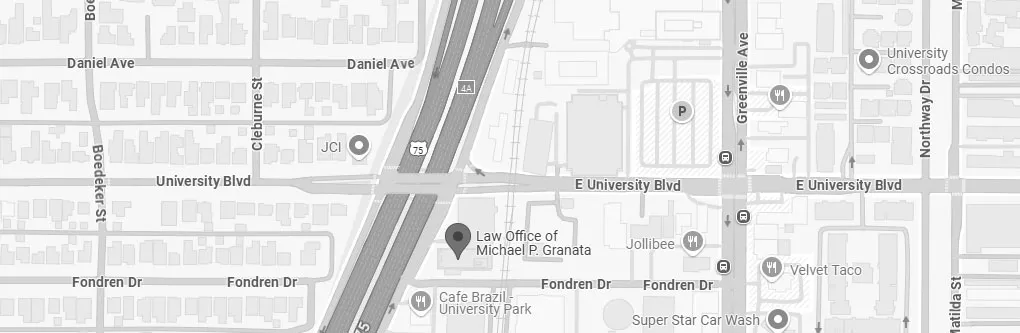
Law Office of Michael P. Granata6440 N. Central Expressway, Suite 450, Dallas, Texas 75206 Phone: (214) 977-9050 Schedule a Dallas divorce lawyer consultation today. |
Frequently Asked Questions About Dallas County Standing Orders
What happens if I violate a Dallas County standing order?
If you violate a standing order and your spouse files for enforcement, a judge can hold you in contempt of court. Consequences may include fines, repaying what was lost, covering your spouse’s attorney’s fees, and in serious cases, jail time. Just as damaging, a violation undermines your credibility with the judge for the rest of the case.
Do standing orders apply in both contested and uncontested divorces in Dallas?
Yes. Whether you are working with an uncontested divorce attorney in Dallas on an amicable split or fighting a contested divorce in Dallas, the standing order applies to every qualifying divorce and SAPCR filed in Dallas County. It binds both spouses regardless of how cooperative the case is.
Can a standing order stop my spouse from taking our children?
A Dallas County standing order prohibits either parent from removing the children from the state to change their primary residence and from hiding them from the other parent. It does not, by itself, set a possession schedule. If you need an enforceable parenting schedule fast, a child custody lawyer in Dallas can ask the court for temporary orders.
How does a standing order affect child support?
The standing order preserves the financial status quo but does not set a support amount on its own. To establish payments while the case is pending, you ask the court for temporary orders. A Dallas child support attorney can calculate guideline support and present it to the judge so both households remain stable during the divorce.
Do standing orders treat fathers and mothers differently?
No. Texas standing orders are gender-neutral and bind both parents equally. The same protections and restrictions apply whether you are pursuing fathers’ rights in a Dallas divorce or protecting mothers’ rights in a Dallas divorce. Courts focus on the best interest of the children, not the gender of the parent.
How much does a Dallas divorce lawyer consultation cost, and is affordable representation available?
Consultation policies vary by firm. The purpose of an initial Dallas divorce lawyer consultation is to understand your situation, explain your options, and outline likely costs honestly. If budget is a concern, ask directly about fee structures — an affordable divorce lawyer in Dallas should be transparent about pricing and help you understand what your case realistically requires.
What qualifications should I look for in a Dallas family law attorney?
When evaluating Dallas family law attorney qualifications, look for substantial experience in Texas family law and Dallas-area courts, clear and honest communication, transparent pricing, and a track record you can verify. Reading Dallas divorce attorney reviews and asking how the attorney has handled cases like yours will help you find the best divorce lawyer in Dallas for your situation.
Talk to a Dallas Divorce Attorney Before You Make Your Next Move
The first days after a divorce is filed are when good people make costly mistakes — usually because no one explained the rules. You do not have to navigate the standing order alone, and you should not have to guess what is allowed.
If you are considering divorce or have just been served, reach out for a confidential consultation. We will read your specific standing order with you, explain exactly what it means for your money, your children, and your daily life, and build a lawful, strategic plan from day one. Searching for a “divorce attorney near me” is a good start — but the right Dallas divorce attorney will give you something better than search results: clear answers and a steady hand.
Ready to protect your future?Call the Law Office of Michael P. Granata at (214) 977-9050 to schedule your consultation. |
This article is provided for general informational purposes only and does not constitute legal advice. Standing orders vary by county and are periodically updated; always review your specific order with a licensed Texas attorney. Reading this article does not create an attorney-client relationship.